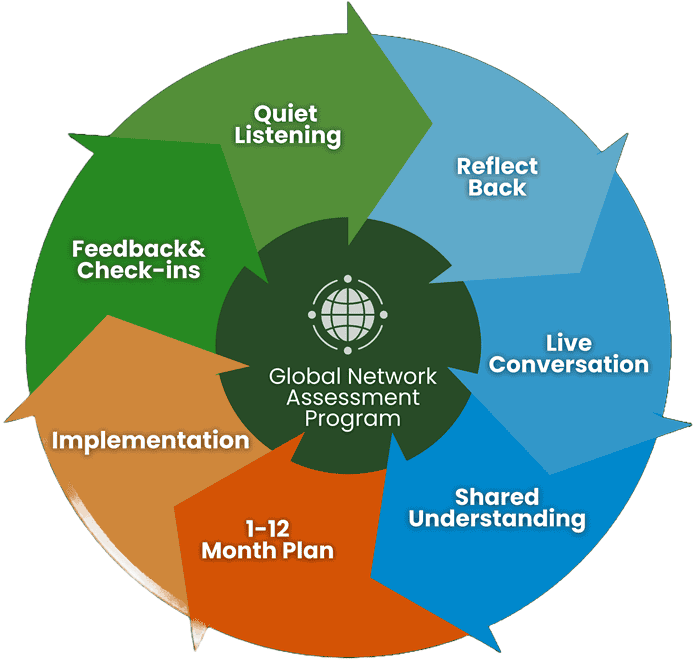
What the Global Network Assessment Program (GNAP) is and who it is for
The Global Network Assessment Program (GNAP) is Telecom4Good’s structured process for looking at your entire technology landscape across headquarters and every country office. It brings together what you are spending, how your networks actually perform, and where staff are struggling, then turns that into a clear, shared plan for improvement.
GNAP is designed for nonprofits and NGOs with more than one location, especially organizations with international or regional offices that make their own IT decisions. It serves IT leaders, operations and program directors, and executives who need a single, trusted picture of what is really happening across all their sites.
When You Should Care About GNAP
- You are unsure where your technology budget is going
- You hear conflicting stories from different offices
- You suspect you are overpaying for underperforming networks
- Rebuild trust between HQ and field teams
- Uncover real issues staff face every day
- Create a practical 1–12-month roadmap
- Agreement on what to fix first, what it will cost, and how it supports your mission
The assessment helps you rebuild trust between HQ and field teams, uncover real issues staff face every day, and create a practical 1-12-month roadmap so everyone agrees on what to fix first, what it will cost, and how it supports your mission.
The real problem is not the network, it is the silence
Common patterns we see:
- Staff try to fix problems quietly and only escalate when things are critical.
- Local teams worry that raising issues will be seen as a failure, not honesty.
- IT topics are squeezed into project calls, so deeper issues never surface.
- Headquarters assumes that "no news" means "no problems," even when systems are fragile.
By the time HQ hears about an outage, a security issue, or a failing system, it is usually urgent and expensive
GNAP is designed to break that pattern. It give global offices a safe way to say, "Here is what is hard right now," and it gives headquarters a clear way to listen and respond.
A psychological approach that makes your offices feel supported, not inspected
The Global Network Assessment Program is built around human behaviors and culture, not just hardware and circuits
When we say GNAP is a psychological approach, we mean:
- It starts gently, with a brief online survey and a warm introduction, rather than a long technical audit.
- It reflects back what offices tell you, so they feel heard and taken seriously.
- It uses open-ended questions in live conversations, not rapid-fire checklists.
- It validates what you heard with each office before you propose any changes.
- It turns your promises into realistic commitments that you can actually keep.
For many country offices, especially in regions like Africa, Latin America, and Southeast Asia, this approach feels very different from traditional top-down IT programs. Over time, they learn that it is safe to share problems early, because headquarters is there to help, not to judge.
What your organization gains from the
Global Network Assessment
GNAP gives headquarters and country offices a shared picture of your networks, costs, and risks, so you can make better decisions with less guesswork.
Nonprofits uncover unused circuits, duplicated services, and overbuilt solutions so they can redirect budget to programs instead of unnecessary IT spend.
By mapping every office’s connectivity and equipment, you reduce outages and slow connections that disrupt staff, field teams, and program delivery.
HQ and local offices work from the same set of facts, which reduces tension, builds trust, and makes it easier to agree on next steps.
You receive a prioritized 1–12 month roadmap that shows what to fix first, what it will cost, and what can wait, so leadership can commit with confidence.
Three ways to run your Global Network Assessment
Self-Guided Assessment – “Do it yourself with our framework”
For teams that want to lead the process internally
The Self-Guided Assessment gives your team a proven structure so you can run the Global Network Assessment yourself.
- A step-by-step plan for how to introduce GNAP to your country offices.
- Survey templates, email outlines, and call guides.
- A framework for documenting each office’s environment and pain points.
- A simple model for turning your findings into a prioritized action plan.
Your staff lead the conversations with your offices. We provide the process, questions, and tools so they do not have to invent the approach from scratch.
Assisted Assessment – “You lead, we support”
For organizations that want expert help at key stages
With the Assisted Assessment, your team is in the driver’s seat, and Telecom4Good joins you where you need us most.
You get everything from the Self-Guided Assessment, plus:
- Help customizing surveys, emails, and call scripts for your specific culture and regions.
- The option for Telecom4Good to join selected calls with country offices.
- Expert review of your findings, risk assessments, and proposed solutions.
- Feedback on your 1, 3, 6, and 12-month plan before you share it with leadership.
This is ideal if you have the capacity to run much of the process, but want reassurance and support from a partner that has already done it many times.
T4G Guided Assessment – “Fully guided by Telecom4Good”
For NGOs that want an end-to-end, expert-led process
In the T4G Guided Assessment, Telecom4Good leads the Global Network Assessment for you, in close partnership with your stakeholders.
- Works with HQ to plan the rollout and communication to offices.
- Customizes surveys and outreach to match your culture and context.
- Leads or co-leads interviews and live calls with your country offices.
- Gathers detailed technical and operational information, including diagrams and supporting documents where needed.
- Produces a clear set of findings, risks, and recommendations for each office.
- Builds an organization-wide plan with budgets, timelines, and priorities.
- Supports you through implementation, post-assessment feedback, and satisfaction checks.
Many organizations choose this option for their first Global Network Assessment, then move to an Assisted or Self-Guided model in future cycles.
Frequently Asked Questions
Wondering whether this program is a good fit for your nonprofit? These questions and answers are designed to help you make an informed decision.
What is the Global Network Assessment Program (GNAP)?
The Global Network Assessment Program (GNAP) is Telecom4Good’s structured process for evaluating your entire technology landscape across headquarters and every country or regional office. It brings together how each office connects to the internet, what you are paying, how reliable those connections are, what security risks exist, and where staff are struggling. The outcome is a clear, shared picture of your global network and a prioritized 1, 3, 6, and 12-month roadmap that HQ and field offices agree on.
What problems does GNAP solve for nonprofits and NGOs?
GNAP is designed for organizations where offices make their own IT and connectivity decisions, leadership does not have a single, trusted view of costs, performance, and risks, and field teams feel unheard or HQ hears conflicting stories from different locations. The program replaces guesswork with evidence. It helps you identify overspending, unreliable circuits, security gaps, and day-to-day pain points that never show up on a spreadsheet, then turns that information into a practical plan that balances budget, risk, and staff capacity.
Who is GNAP designed for inside the organization?
GNAP is built for nonprofits and NGOs with two or more offices, especially those with international or regional locations. Typical stakeholders include IT directors and network leads, operations and program directors, finance leaders responsible for IT spend, and executive leadership that needs a single, trusted view of the organization’s technology footprint. It is especially valuable when HQ, IT, and field offices need a common language and set of facts to plan future investments.
How is GNAP different from a traditional IT or network audit?
A traditional audit usually focuses on compliance and technical configuration. GNAP focuses on how technology actually supports or blocks program delivery in each office, the lived experience of staff rather than only device lists and circuit inventories, building trust between HQ and field offices instead of making local teams feel inspected, and producing a plain language roadmap that non-technical leaders can understand and act on. GNAP still looks at connectivity, contracts, risks, and equipment, but it does so through a nonprofit lens with an emphasis on collaboration and long-term sustainability.
What will our organization receive at the end of a GNAP engagement?
At the end of GNAP, your organization receives a consolidated view of connectivity, ISPs, contracts, and costs for each participating office, a summary of key issues and risks by office and across the organization, identification of patterns, savings opportunities, and areas where standards should be updated, a prioritized 1, 3, 6, and 12 month roadmap that lists what to address first, what it will roughly cost, and what can wait, and supporting documentation that leadership can use for budgeting, board updates, and vendor discussions. These deliverables are written in plain language so both technical and non-technical stakeholders can use them.
How long does the Global Network Assessment take, and how much staff time is required?
The timeline depends on how many offices are involved and which assessment path you choose, but the structure is consistent. Alignment takes roughly 5 to 25 days to agree on goals, scope, and participating offices. Assessment and Analysis takes 20 to 60 days for surveys, calls, data collection, and analysis. Review and Planning takes 3 to 7 days to review findings with stakeholders and finalize the roadmap. Implementation and follow-up vary based on the size of changes and office responsiveness. Most country offices are asked to complete a short survey, share key documents such as invoices or contracts, attend one or two structured calls, and review a plain language summary of their situation.
What are the differences between Self Guided, Assisted, and T4G Guided GNAP?
The Self-Guided assessment gives your team the full GNAP framework, templates, and thought process so you can run the assessment internally and own the schedule and communication with offices. The Assisted Assessment includes everything in Self-Guided plus support from Telecom4Good at key stages, such as customizing surveys, joining selected calls with offices, and reviewing your findings and roadmap. The T4G Guided Assessment is a fully guided process where Telecom4Good leads the assessment in close partnership with your stakeholders, handles most of the data gathering, interviews, and analysis, and delivers a complete findings package and roadmap for leadership. You can start with Self-Guided and move to Assisted or T4G Guided later if you need more support.
How many offices should participate, and can we start with a smaller pilot?
GNAP delivers the most value when you include at least two offices, ideally in different regions. Many organizations start with headquarters, one or two large country or regional offices, and one smaller or more remote office. This mix gives you a realistic picture of how conditions differ. You can then expand the assessment to more offices in future phases using the same framework.
How intrusive is GNAP for our field offices and local staff?
GNAP is designed to be respectful of local workloads and expertise. Offices are not asked to produce complex technical documentation if they do not have it. Instead, Telecom4Good uses short, structured surveys, guided calls with clear agendas, and requests for practical artifacts such as photos of equipment rooms, recent invoices, and circuit details. Local teams always know how their input will be used, and each office receives a reflect back summary so they can correct or clarify what was captured before recommendations are made.
What information or data do we need to provide?
Depending on your assessment path, you may be asked for internet and network invoices or contracts by office, any existing network diagrams or inventories if they exist, lists of key applications and systems used at each office, and recent incidents such as outages, security events, or recurring support issues. Telecom4Good helps you prioritize what is essential, so the process does not become a burden for your teams.
Can GNAP be run in multiple languages and time zones?
Yes. Telecom4Good’s Guided Global Network Assessment can be run in English, French, and Spanish, with scheduling that respects local time zones. This makes it easier to gather accurate information from international offices and ensure that staff fully understand the questions, findings, and recommendations.
How often should we repeat a Global Network Assessment?
Most organizations find value in running a full GNAP every two to three years, or sooner if there are major changes such as rapid expansion, large mergers, new regulatory requirements, or persistent outages and complaints. Between full assessments, the original roadmap can be used as the baseline for annual planning and budgeting.